
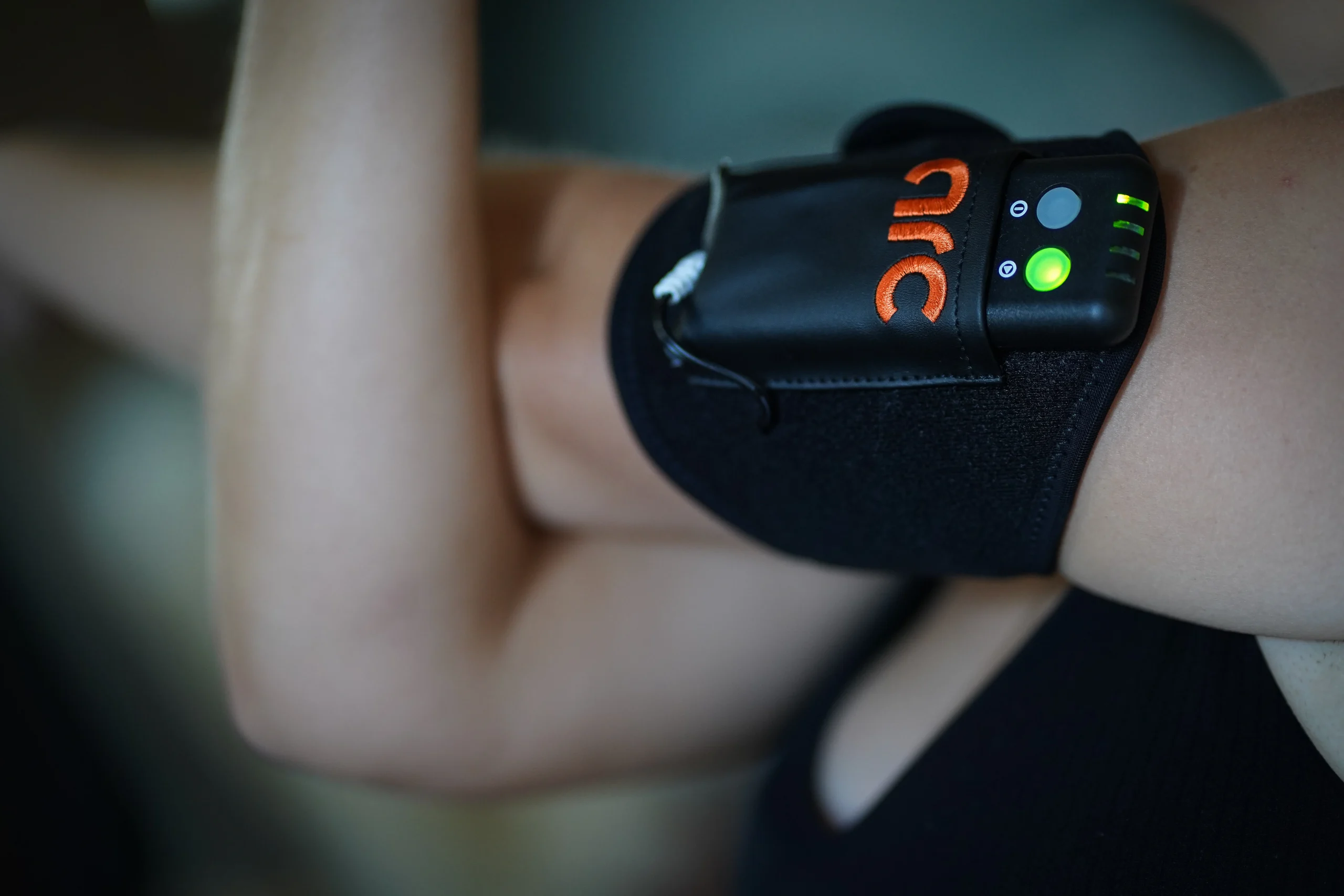
The Arc4Health offers the microcurrent in the range 0 – 500 μA administered via the strap attached to either the upper arm or ankle. Utilising subsensory microcurrent, most users do not feel any sensation during treatment. (This is completely normal and does not mean the device is not working.)
This blog post explores the scientific research into the mechanisms of microcurrent therapy (MCT) and how it may support the body’s recovery from physical exertion, accelerate muscle recovery, and enhance performance.
Proposed physiological mechanisms include:
1. Enhanced cellular energy production
Specific microcurrent intensities have been shown to increase adenosine triphosphate (ATP) production in tissues. ATP is the primary energy source used by cells during repair and regeneration. (1)
ATP serves as the primary energy carrier within living cells, providing the chemical energy required to drive a wide range of biological processes. Structurally, ATP consists of an adenosine molecule bound to three phosphate groups. When the terminal phosphate bond is hydrolysed, energy is released to support cellular processes, producing adenosine diphosphate (ADP) and inorganic phosphate (Pi).
Through the process of cellular respiration, the energy derived from nutrient metabolism is utilised to re-phosphorylate ADP, reforming ATP. This continual cycle of ATP hydrolysis and resynthesis enables cells to maintain a readily available supply of energy. As a result, ATP functions as the universal energy intermediary, supporting essential cellular activities including ion transport, protein synthesis, muscle contraction, and tissue repair. (2)
2. Improved tissue repair
Following exercise or injury, tissues undergo a repair process involving inflammation, collagen production, and cellular regeneration. Microcurrent may help support these processes by influencing cell signalling and protein synthesis. (1)
MCT can influence various intracellular signalling pathways, such as PI3K, cAMP, PTEN, ERK1/2, and calcium signalling. These pathways are involved in regulating cellular regeneration, tissue repair, and physiological responses. Additionally, the bioelectrical signals facilitated by MCT can enhance communication between cells, which is essential for coordinated cellular responses. This can underpin efficient growth, organisation, morphogenesis, and regeneration in tissues. (3)
3. Reduced muscle soreness and accelerated recovery of muscle performance
A 2026 systematic review and meta-analysis of 11 randomised controlled trials found that microcurrent therapy significantly reduced delayed onset muscle soreness at both 24 and 48 hours after exercise-induced muscle damage. (4)
These findings support the notion that microcurrent therapy may influence post-exercise recovery time and, therefore, may serve as a useful tool to support recovery. Further, a double-blind randomised crossover study in college sprinters reported that microcurrent electrical neuromuscular stimulation accelerated recovery of hamstring strength and reduced muscle soreness following repeated high-intensity sprint and resistance training. (5)
Microcurrent Therapy for Delayed Onset Muscle Soreness (DOMS)
A meta-analysis into the effects of microcurrent therapy on the recovery of muscle performance after high-intensity training sessions found that microcurrent therapy (MCT) appears to be effective in reducing delayed onset muscle soreness (DOMS) following exercise.
This review highlighted considerable variation between studies in the type of current used, treatment duration, and stimulation settings, making it difficult to identify a single optimal protocol. However, the most successful studies generally used complex pulsed microcurrent patterns, current intensities ranging from 20 to 400 μA, and longer treatment durations of up to three hours. The microampere unit is the same as administered through the Arc4Health, with the range offered being 0-500 μA, depending on the programme selected.
Microcurrent is thought to exert both local and systemic effects. This is due to the current alternating between positive and negative pulses, meaning the therapeutic effect is not limited to the exact location of the electrodes. As a result, electrode placement appears to have minimal influence on treatment outcomes, suggesting that microcurrent may support recovery throughout the body rather than only at the application site. This supports the evidence that microcurrent may act systemically and can be applied anywhere on the body where a stable connection can be maintained throughout the treatment period.
In summary, the current evidence suggests that appropriately delivered microcurrent therapy can help reduce exercise-induced muscle soreness, with the strongest results seen when using complex pulsed currents, microampere intensities, and longer treatment times. (4)
Case Studies
C. Chamberlayne, 7th October 2025.
As an aside I always use the Arc at night, and I have continued to use it now most nights. It aids with general aches and pain including helping with menstrual cramps, but where it works on the circulation it also has very beneficial effects on reducing hangovers too! My partner is a serving military officer and an elite fitness competitor he has now being using his Arc4health every night for 6 months and has noticed a significant improvement in his exercise recovery times and his overall injury healing from many post exercise related niggles.
A. Coggins, 7th April 2025
I had a flu virus over Christmas whilst still using the device and recovered more quickly than the other members of my family. By mid-January I was noticing less DOMs post-exercise sessions and by February I could train (30mins – 1hr gym classes, HIIT sessions and advanced reformer Pilates) on back-to-back days. Something which I have always struggled with since recovering from muscle disease. I carried on using the device most days after the initial 6 weeks generally in program 2 or on 3 or 4 if I felt I needed help with tissue repair. At the end of March, I started the 6-week program again and I am now on week 2 and appreciating the anti-inflammatory effects again.
Since starting using ARC I have:
- more consistent energy levels
- zero muscle and joint pain
- far less gut bloating
- Improved brain fog
- zero post exertional malaise
Anonymous
I am an active retiree who from April this year was experiencing aches in bones. joints and muscles for no obvious reason. Before speaking to a doctor, I decided to try the Arc. During the time since buying, the aches have eased and I have found that any subsequent strains on my muscles caused by day-to-day activity or specific exercise have been helped by the Arc.
These results have convinced me to wear the Arc daily to manage my body condition and over this time I believe it has helped me.
Adam, Jul 4, 2018
Trustpilot review: Rated 5 out of 5 stars
Great product!
I have been using the Arc4Health for over a year and now wouldn’t be without it! I have found that I recover so much faster after exercise, and sleep so much better. The team in the office are knowledgeable and supportive – thank you Arc!!
- Kolimechkov S, Seijo M, Swaine I, Thirkell J, Colado JC, Naclerio F. Physiological effects of microcurrent and its application for maximising acute responses and chronic adaptations to exercise. Eur J Appl Physiol. 2023;123(3):625-640.
- ARC Microtech. Arc4Health: Enhancing Health Naturally [Internet]. [cited 2026 Oct 1]. Available from: https://arcmicrotech.com/arc4health/
- Arc4Health. How microcurrent therapy facilitates modulation of cellular signalling pathways [Internet]. 2025 [cited 2026 Oct 1]. Available from: https://arcmicrotech.com/arc4health/how-microcurrent-therapy-facilitates-modulation-of-cellular-signalling-pathways/
- Kolimechkov S, Seijo M, Thirkell J, Larumbe-Zabala E, Naclerio F. Effects of microcurrent with exercise on muscle soreness: a meta-analysis. Rev Iberoam Cienc Act Fis Deporte. 2026;15(2):247-267.
- Hiroshige Y, Yamaguchi R, Iriguchi K, Sudo T, Kato H, Ohyama-Byun K. Prevalence and sport-specific comparison of lateral ankle sprain and chronic ankle instability in 2200 collegiate athletes. Foot Ankle Spec. 2026 Mar 28.
- ARC Microtech. Arc4Health: Enhancing Health Naturally [Internet]. [cited 2026 Oct 1]. Available from: https://arcmicrotech.com/arc4health/